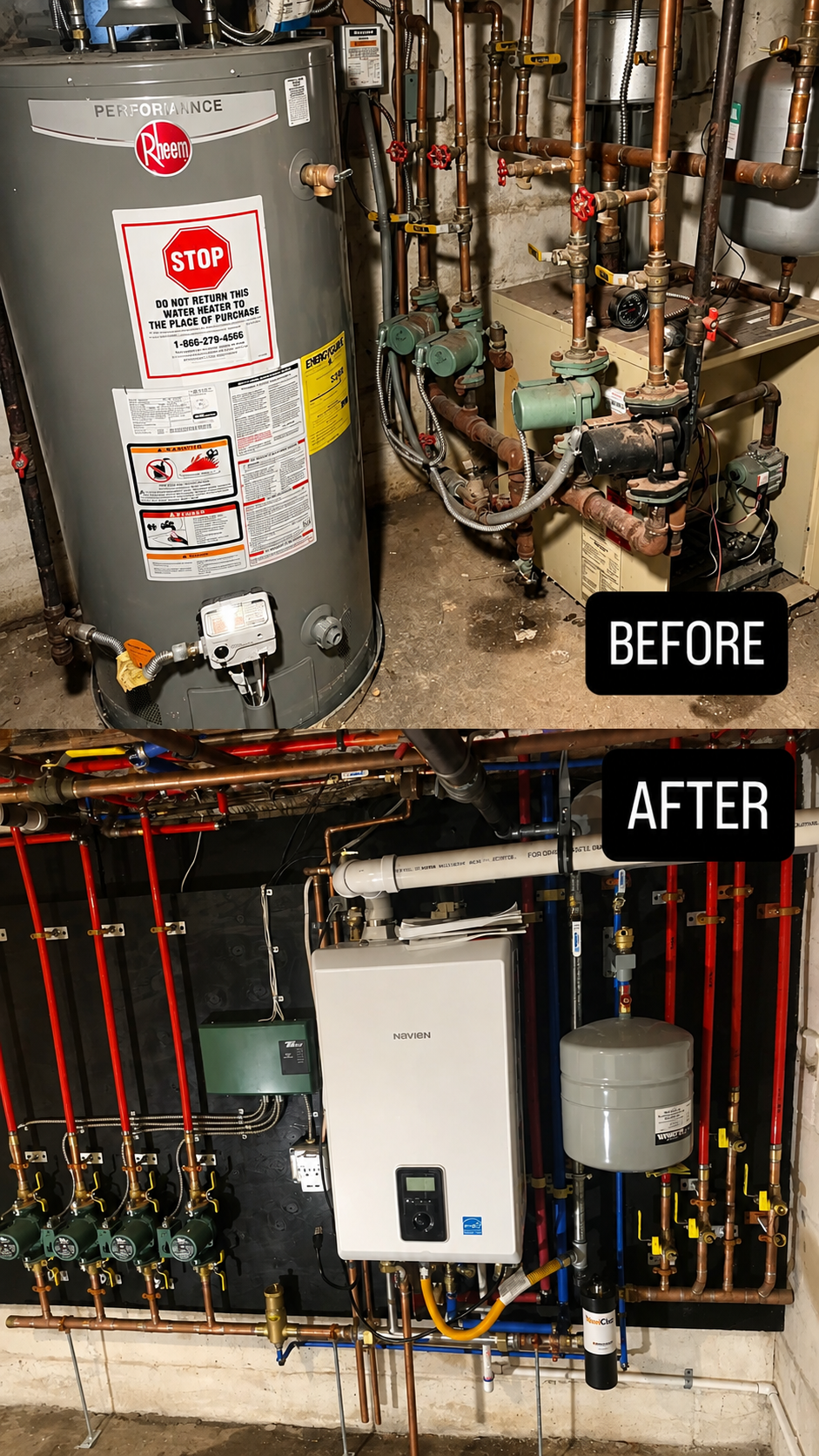
A tankless water heater is a legitimate upgrade for many Ocean County homes, especially households with high hot-water demand or owners who plan to stay put long enough to benefit from improved efficiency and a longer service life. But a conventional tank replacement can be the smarter choice when budget, existing gas capacity, venting, and daily usage patterns make a conversion less practical. Patriot Plumbing helps homeowners in Toms River, NJ, Brick, NJ, and throughout Ocean County compare both options based on the home—not a one-size-fits-all sales pitch.
How Tank and Tankless Water Heaters Work
A traditional storage-tank water heater heats and stores a set volume of water—commonly 40, 50, or more gallons—until a faucet, shower, or appliance calls for it. As hot water leaves the tank, cold water enters and the system reheats the supply. It is a familiar, dependable design, but it uses energy to maintain stored water at temperature even when no one is using it.
A tankless water heater heats water on demand. When a hot-water fixture turns on, water flows through the unit’s heat exchanger and is heated as it passes through. Because there is no large reservoir to keep hot around the clock, a tankless system can reduce standby energy losses. The tradeoff is that the unit must be properly sized for the home’s simultaneous demand—such as showers, laundry, and a dishwasher running at the same time.
Upfront Cost vs. Long-Term Value
For many homeowners asking whether a tankless water heater is worth it in NJ, the honest answer is: it depends on how long you will own the home and how much hot water you use. A standard tank replacement usually has a lower initial cost and can often use much of the existing setup. That makes it an appealing choice when a failed water heater needs to be replaced quickly or when the current installation is otherwise straightforward.
Tankless equipment and installation generally cost more upfront. However, high-efficiency gas tankless units heat water only when it is needed, which can lower energy use compared with an older or less-efficient tank unit. The financial benefit is strongest for households with consistent hot-water usage and owners looking at long-term operating costs rather than purchase price alone. A tankless unit may also have a longer potential service life when it is installed correctly and maintained on schedule.
Patriot Plumbing can help put realistic numbers around the decision by reviewing your current fuel type, hot-water habits, equipment location, and required installation work. The goal is to choose the system that delivers reliable hot water and appropriate value for your household.
What a Tank-to-Tankless Conversion Actually Involves
Can you replace your tank water heater with tankless? Often, yes—but it is not always a simple swap. A tankless water heater installation in Ocean County may require upgrades beyond the appliance itself.
- Gas-line sizing: Gas tankless units can require substantial fuel input while operating. The existing gas line must be evaluated for pipe size, length, other gas appliances, and available capacity.
- Venting modifications: A tankless unit requires approved intake and exhaust venting that matches the manufacturer’s specifications and local code requirements. The old tank’s chimney or vent connection may not be usable.
- Condensate drainage: High-efficiency condensing models produce condensate that needs a correctly routed drain and, where appropriate, neutralization or a pump.
- Electrical and plumbing updates: The installation may need a nearby electrical connection, isolation valves for servicing, water-line adjustments, and a suitable mounting location.
These details are why professional design and installation matter. Patriot Plumbing is certified by Navien and Rinnai, and every mechanic has completed manufacturer training. That experience helps ensure a new system is sized, vented, drained, and commissioned for dependable performance.
Who Benefits Most From a Tankless Water Heater?
Tankless water heaters are especially compelling for larger or busier households that regularly exhaust a tank’s hot-water supply. If multiple people shower in the morning, teenagers take long showers, or the washer and dishwasher often run at the same time, the right tankless model can provide a more continuous supply of hot water.
They are also a strong option for homes with limited utility-room space. Wall-mounted tankless systems free up floor area that a bulky storage tank occupies. Finally, homeowners planning to remain in a Toms River or Brick home for many years may be better positioned to appreciate the long-term efficiency and durability benefits of a tankless upgrade.
That said, “endless” hot water does not mean unlimited flow at every fixture. Cold incoming winter water, the number of fixtures in use, and the unit’s gallons-per-minute capacity all affect performance. Proper sizing is essential.
Ocean County Factors to Consider
Coastal storm preparedness is a practical consideration in Ocean County. Most gas tank water heaters can still heat water during a power outage if their ignition and controls do not require household electricity. By contrast, gas tankless water heaters use electronic controls, fans, and ignition, so they generally will not operate when the power is out. A properly sized backup-power solution may be worth discussing for homeowners who rely on tankless equipment and want greater outage resilience.
Local water conditions matter, too. Mineral sediment can collect inside a conventional tank, reducing efficiency and contributing to wear over time. Tankless units do not have a storage tank, but they still benefit from periodic flushing and maintenance to protect the heat exchanger. Whether you choose tank or tankless, annual maintenance can help extend equipment life and identify issues before they become a no-hot-water emergency.
When a New Tank Is the Better Choice
A high-quality tank water heater remains an excellent solution for many homes. It may be the better fit when the household has moderate demand, conversion-related gas or venting work would be extensive, the budget is limited, or a fast replacement is the immediate priority. Modern tank units are more efficient than many aging models, and selecting the proper capacity can improve comfort without requiring a larger project.
For a straightforward replacement or help with any water-heater issue, explore Patriot Plumbing’s Water Heaters
services. For broader repairs, upgrades, and home plumbing needs, visit Plumbing Services.
FAQ
How much does tankless water heater installation cost in Toms River?
Installation cost varies based on the unit’s capacity, gas-line requirements, venting route, electrical needs, condensate drainage, and access to the installation area. A site visit is the best way to receive an accurate estimate.
Can I replace my tank water heater with a tankless model?
In many cases, yes. Before converting, a qualified plumber should evaluate gas capacity, venting, drainage, water lines, and the home’s peak hot-water demand.
Will a tankless water heater work during a power outage?
Most modern gas tankless units need electricity for their controls and fan, so they typically stop operating during an outage unless backup power is available. Your specific tank system may operate differently depending on its ignition and controls.
Does a tankless water heater need maintenance?
Yes. Periodic service, including flushing when appropriate for the water conditions, helps maintain efficiency and protect internal components.
Which option is right for my home?
The right choice depends on your household’s demand, available space, fuel and venting setup, budget, and how long you expect to remain in the home. Call Patriot Plumbing at 732-929-3529 or request a free estimate to assess the best water-heater solution for your Toms River, NJ, Brick, NJ, or Ocean County home.